I have been pretty fascinated by the use of the term "boyfriend" to describe women's styles borrowed from menswear. First of all, it's kind of heteronormative . Then I came across this article from Canada that puts a different spin on the styles. The author, Rachel Matlow, reports on the emergence of brands catering to female customers who, 50 years ago, might be called tomboys. That term strikes me as rather archaic these days. About 25 years ago, my daughter asked me what a "tomboy" was and I tried to explain that it was a girl who liked to do "boy" things. "Like what"", she asked. "sports, bugs, being outdoors...um..." I struggled. "Those are all girl things," she said.

How many decades until a plain tailored blazer or classic banded cardigan is no longer menswear?
 
 
I've done a flurry of interviews -- three in under two weeks -- and all of them for radio stations on the other side of the world. Here is the last one, a short segment with Radio New South Wales in Australia. Enjoy!

For my friends in the Washington, DC area, I will be giving a "Pink and Blue" talk this afternoon at 4:30 at McKeldin Library on the U of Maryland campus.

I have learned so much since I finished the book, not only about gender and clothing but also about "common knowledge". If I only had a dollar for every time I've been asked if it's true that the colors "used to be the opposite". In the book, in every article I have written and in every talk and interview, I've been careful to explain that the current rule is unusually strict compared to the way pink and blue were used in the past, and that the rule was reversed in some places (Belgium, for example). In the US, there is a l-o-n-g period of time where there is no uniform rule, before the current symbolism is completely incorporated. Is it so difficult to imagine a world where pink and blue did not signify gender?


My Radio New Zealand interview is now available online. It runs nearly 30 minutes. The host asked some very thoughtful questions. Enjoy!
 
 
Here's a great post from Kyle Wiley of The Good Men Project (re-blogged via the Huffington Post, but hey, Arianna's rich enough). My favorite line:
It’s not just “a” girl color, but the international spokescolor (yes, a made up word) for the female gender.
Made up words are the best, because like all custom-made items, they fit better than the off-the-rack-versions. That is exactly the idea I have been trying to get across, less articulately, when I talk or write about pink and blue. Blue is NOT a spokescolor; pink is a spokescolor. Why is that, do you think? Is there something magical about pink itself? Mais non.

The magic is one of the oldest known superpowers: giving birth. Stay with me, friends. Here's how I see it: Women used to be powerful because they gave birth. The only way men could be more powerful than women was to control reproduction -- through marriage, through rape, through laws about birth control and abortion. But none of that transfered the magical power from women to men, so a cultural solution emerged instead. Make birth dirty, make sex a sin, make women dirty, weak sinners, lower than men because of their magic power.

Now all you have to do to maintain male superiority is make sure they are not tainted by anything remotely effete or feminine. Punish homosexuality. Raise little boys to be not-girls. Ridicule boys --and men-- who cry, or who are unathletic, or who like pink. It's a small price to pay for a place at the top of the social order.

Why have women put up with this? Many reasons, including a need to protect their offspring, their own survival and this complicated force called "hegemony", which results in acceptance of the dominant culture even when it works against you. (Kind of a cultural Stockholm syndrome.) But all is not lost; there are men and women, mothers and fathers, who believe that all humans have magical powers of love, imagination and creativity, and that humanity will benefit when every baby is valued for its potential to love, imagine and create, not its role in human reproduction.

Peace. (Steps off soapbox, returns to her index cards.)
 
 
Maybe you thought we'd settled the pants-for-women question back in the 1970s. Think again! A high school in California is laying down the law: girls must wear gender-appropriate clothing for prom and for yearbook photos. Guess they never saw Marlene Dietrich in a tuxedo.
 
 
I sat in my home Tuesday evening doing a live Wednesday morning radio show. Yes, we're talking about Australia's Life Matters. The comments on the station's blog made me wish I had access to real time travel. The first takes the show to task for presenting my work as "news" when actor Stephen Fry had the same information on his quiz show Qi three years ago. The second commenter recalls an even older John Cleese film about pink and blue.

I love Fry and Cleese, and I think they are both well-read and well-informed. They might have done their own inquiry about pink and blue, but it's more likely they read or heard about it from someone who did the research. It could be me, since I've been writing articles and doing interviews about pink and blue for 30 years. It could also be British historian Clare Rose, who has done parallel work in the UK, or some uncredited media intern.

Oh, for a real time machine! A researcher could publish the results of years of research at the moment of the first discovery!


From the Perryville, Arkansas school dress code, 1972:

After checking in some stores and talking with parents concerning the girls' dress, we have decided to relax the code. We will allow jeans that are made for girls to be worn, providing:

If the jeans open in front, a tunic or square-tailed blouse must be worn to conceal the opening. If the jeans open on the side, then an ordinary blouse may be worn.
Picture
Oh, the horror of girls in fly-front jeans! (Sears, Fall 1972
 
 
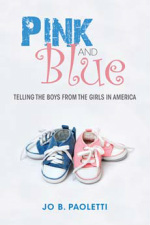
For those of you who prefer the real, page-turning experience of ink on paper, but like your books flexible, light-weight and less expensive, I have excellent news. The paperback version of Pink and Blue has arrived at the publisher's warehouse. Click, order and it's a very short wait...
 
 
Picture
One of the examples I use to show how pink used to be an acceptable color for boys is Walt Disney's 1953 animated film, Peter Pan. The youngest child, Michael, wears pink pajamas throughout the entire movie. (Don't take my word for it: just search for images for "Disney Peter Pan Michael")

Picture
Disney is re-leasing a special DVD version this year, and I've caught a few of their TV ads. It sure looks like Michael's pj's have been re-colored. All I have been able to find online is the cover art (on the left). Has anyone seen the new version?

Please don't tell me they got rid of the pink pajamas and left in "What made the Red Man red".

ETA: I suppose I should be grateful they didn't change Wendy's dress to pink.


  • “You’re a liberal or a conservative in America if you think the ’60s were a good thing or not. If the ’60s was a good thing, you’re left. If you think it was a bad thing, you’re right. And the confusing thing for a lot of people that gets a lot of Americans is, when they think of the ’60s, they don’t think of just the sexual revolution. But somehow or other — and they’ve been very, very, clever at doing this — they’ve been able to link, I think absolutely incorrectly, the sexual revolution with civil rights.”
  • source: Rick Santorum and repealing the 1960s (Charles Blow for the New York Times)

Picture
Girls' swimsuits, Sears 1963
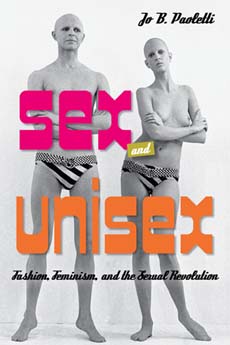
One of the reasons I wanted to write about unisex fashions is that they seem emblematic of a very complicated -- and unfinished -- conversation about sex, gender and sexuality. Rick Santorum's comment from last year is one expression of that conversation, and I thank him for being so honest in putting it out there. Many of us who grew up in the 1960s have mixed feelings about that era, though mine are more positive than Mr. Santorum's. Unlike him, I feel that family planning is good, abortion should be safe, legal and accessible regardless of income and that biological sex is an interesting category but not my be-all and end -all.

But here's the catch: something happens in the coding for feminine clothing in the 1960s that essentially conflates femininity, youth and sexual attractiveness, and it shows up in girls’ clothing. Six-year-olds in bikinis -- thank the 1960s.


More to come, as I am deep in writing mode for the next nine months. This site will also be changing to reflect the widening scope of my work. In my ample free tie, as they say.