One of the questions I hear most often is deceptively simple: when did pink become a girls' color and blue a boys' color? The short answer is that there was no single switch. American retailers and advice writers spent most of the twentieth century teaching parents to sort baby clothes by sex, and white layettes came first. This post walks through the retail timeline I use when I teach or write about early childhood dress. For more posts on gender and clothing history, visit the Gender Mystique blog home.
The era of white (roughly 1890-1920)
Before mass-produced colored dyes were reliable for frequent washing, white cotton was the practical standard for infant clothing at every income level. Layette sets in Sears, Montgomery Ward, and specialty shops emphasized cleanliness, durability, and quantity: gowns, slips, bands, and caps that could be boiled and bleached. Sex mattered less than size and season. When color appeared, it was often pale yellow, cream, or light blue, and catalog copy treated those shades as interchangeable for "baby", not "boy" or "girl".
Before mass-produced colored dyes were reliable for frequent washing, white cotton was the practical standard for infant clothing at every income level. Layette sets in Sears, Montgomery Ward, and specialty shops emphasized cleanliness, durability, and quantity: gowns, slips, bands, and caps that could be boiled and bleached. Sex mattered less than size and season. When color appeared, it was often pale yellow, cream, or light blue, and catalog copy treated those shades as interchangeable for "baby", not "boy" or "girl".
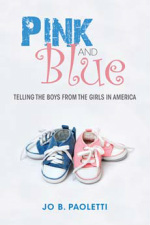
Pink and Blue: Telling the Boys from the Girls in America (Indiana University Press)
Color enters the layette (1920s-1940s)
As synthetic dyes improved and home washing machines spread, manufacturers began offering pastel layettes in pink, blue, and mint. Department stores still disagreed about which color belonged to which sex. Trade papers and parenting magazines from the 1920s sometimes assigned pink to boys and blue to girls, reversing what we expect today. What changed was not a national color law but repeated marketing: coordinated sets, gift packaging, and nursery displays that made it easier to shop if every item matched a label.
Pink for girls, blue for boys (1950s-1970s)
By the postwar years, the pattern most readers recognize had taken hold in mainstream retail. Catalog pages separated "layette for son" and "layette for daughter" with color as the quickest visual cue. Rompers, creepers, and short sets followed. Parents who wanted neutral options could still find white garments, but they had to look harder. The default had shifted from white-as-universal to color-as-coded. My work on 1950s girls' school dresses shows the same logic applied once children left infancy: design details, not just hue, marked the wearer as feminine or masculine.
What this means for researchers today
If you are studying baby cards, layette advertisements, or family photos, note three things: the date of the source, whether the item is part of a marketed set, and what words the copy uses ("infant", "girl", "boy", or no sex label at all). Color alone is never enough. I return to these questions often in posts on baby clothes and in my chapter drafts on dress-up play, including playing cowboy in the 1950s, where older children pushed back against the rules they had learned as toddlers.
The pink-and-blue nursery is a twentieth-century retail habit, not a biological fact. Knowing when that habit took shape helps explain why so many Americans now treat it as timeless.
As synthetic dyes improved and home washing machines spread, manufacturers began offering pastel layettes in pink, blue, and mint. Department stores still disagreed about which color belonged to which sex. Trade papers and parenting magazines from the 1920s sometimes assigned pink to boys and blue to girls, reversing what we expect today. What changed was not a national color law but repeated marketing: coordinated sets, gift packaging, and nursery displays that made it easier to shop if every item matched a label.
Pink for girls, blue for boys (1950s-1970s)
By the postwar years, the pattern most readers recognize had taken hold in mainstream retail. Catalog pages separated "layette for son" and "layette for daughter" with color as the quickest visual cue. Rompers, creepers, and short sets followed. Parents who wanted neutral options could still find white garments, but they had to look harder. The default had shifted from white-as-universal to color-as-coded. My work on 1950s girls' school dresses shows the same logic applied once children left infancy: design details, not just hue, marked the wearer as feminine or masculine.
What this means for researchers today
If you are studying baby cards, layette advertisements, or family photos, note three things: the date of the source, whether the item is part of a marketed set, and what words the copy uses ("infant", "girl", "boy", or no sex label at all). Color alone is never enough. I return to these questions often in posts on baby clothes and in my chapter drafts on dress-up play, including playing cowboy in the 1950s, where older children pushed back against the rules they had learned as toddlers.
The pink-and-blue nursery is a twentieth-century retail habit, not a biological fact. Knowing when that habit took shape helps explain why so many Americans now treat it as timeless.