A romper is a small garment and a large argument. In twentieth-century catalogs it sits between the baby gown and the first real outfit: one piece, usually short, often with snaps, sold by age rather than by a style name anyone would use now. If you only look at the drawing, you will miss the part the retailer cared about. The method below is the one I use when a page of creepers, rompers, or short sets lands on my desk. It also works on the 1950s school dresses, where the telling detail is often a pocket rather than a hue.
1. Read the caption before the picture
Write down every noun in the line under the art: romper, creeper, sunsuit, short set, overall. Then write the words that sort the child: infant, toddler, brother, sister, boy, girl, or none. "Infant" with no sex is a different product from "toddler's" with a sex. The picture can be ambiguous on purpose. The type is where the store commits.
Write down every noun in the line under the art: romper, creeper, sunsuit, short set, overall. Then write the words that sort the child: infant, toddler, brother, sister, boy, girl, or none. "Infant" with no sex is a different product from "toddler's" with a sex. The picture can be ambiguous on purpose. The type is where the store commits.
2. Find the closure
Snaps at the crotch are about diapers, not about gender. Buttons on the shoulder let an adult dress a child who cannot help. A back closing on an older child's garment is a different story, and I have written about that on girls' dresses. On a romper, note where the hand has to go. That tells you the age the maker had in mind more honestly than the smile on the drawn face.
Snaps at the crotch are about diapers, not about gender. Buttons on the shoulder let an adult dress a child who cannot help. A back closing on an older child's garment is a different story, and I have written about that on girls' dresses. On a romper, note where the hand has to go. That tells you the age the maker had in mind more honestly than the smile on the drawn face.
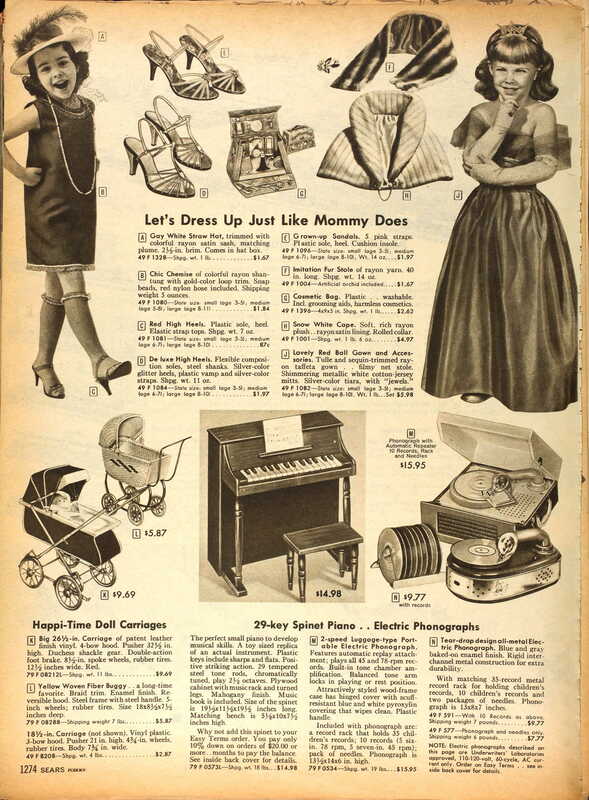
Sears, fall 1959. The picture is not enough. Read the line under it.
3. Count the pockets and the trim
A patch pocket, a bit of embroidery, a collar that lies flat, a ruffle at the leg: these are cheap to print and expensive in meaning. Trim is how a shared pattern becomes two SKUs. If the same cut is offered in two listings, the difference is often three stitches and a word.
A patch pocket, a bit of embroidery, a collar that lies flat, a ruffle at the leg: these are cheap to print and expensive in meaning. Trim is how a shared pattern becomes two SKUs. If the same cut is offered in two listings, the difference is often three stitches and a word.
4. Record color as a list, not a verdict
Copy the colors exactly as printed: "pink or blue," "maize," "mint," "red." Do not translate them into today's code. A maize romper in 1936 is not a clue that the child was a boy. I keep a separate note for cases where the same page assigns pink one way and a later page assigns it the other. That comparison is the subject of when pink was for boys.
Copy the colors exactly as printed: "pink or blue," "maize," "mint," "red." Do not translate them into today's code. A maize romper in 1936 is not a clue that the child was a boy. I keep a separate note for cases where the same page assigns pink one way and a later page assigns it the other. That comparison is the subject of when pink was for boys.
5. Write the age and the price on the same line
Catalog ages are ranges: 6 months, 1 to 3, 3 to 6. Price tells you whether this was the loss leader or the gift item. A 98-cent romper and a fancy version at two dollars can share a drawing and not share a customer. When you have caption, closure, pockets, colors, age, and price, you have a record. The drawing is the illustration of that record, not a substitute for it.
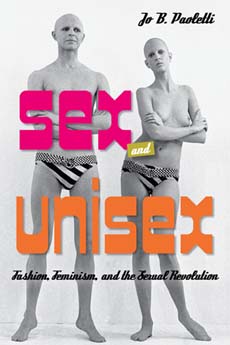
The same habit of splitting one cut into two meanings shows up again in what unisex meant at Sears in the 1970s.
Catalog ages are ranges: 6 months, 1 to 3, 3 to 6. Price tells you whether this was the loss leader or the gift item. A 98-cent romper and a fancy version at two dollars can share a drawing and not share a customer. When you have caption, closure, pockets, colors, age, and price, you have a record. The drawing is the illustration of that record, not a substitute for it.
The same habit of splitting one cut into two meanings shows up again in what unisex meant at Sears in the 1970s.