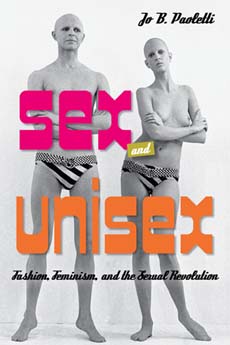
"Unisex" is one of the slipperiest words in the catalogs I read. In the 1970s it shows up in Sears, in newspaper ads, and in magazine stories about jeans and haircuts. Readers now often hear it as a promise: one set of clothes, any child. The pages rarely keep that promise. What they usually offer is a short list of items the copy will not sort, surrounded by pages that still say boy and girl in large type. I have a longer treatment in Pink and Blue. These are the cues I mark first when I am back in a 1970s Sears book.
Pink and Blue (Indiana University Press)
The word is narrower than the rumor
Search the index and the headings, not just the denim photographs. "Unisex" clusters on jeans, T-shirts, sneakers, and sometimes sleepwear. Party clothes, coats with velvet collars, and anything with a ruffle stay in the sexed sections. The store could advertise a mood of freedom on one spread and keep the old sorting on the next. Both spreads are evidence. Using only the free-looking one is how the decade gets remembered as a revolution it only partly was.
Search the index and the headings, not just the denim photographs. "Unisex" clusters on jeans, T-shirts, sneakers, and sometimes sleepwear. Party clothes, coats with velvet collars, and anything with a ruffle stay in the sexed sections. The store could advertise a mood of freedom on one spread and keep the old sorting on the next. Both spreads are evidence. Using only the free-looking one is how the decade gets remembered as a revolution it only partly was.
Shared art, split captions
A single drawing of a child in jeans may be placed between two columns. One column says boys, the other says girls, and the garment differs by a stitch of topstitching or by nothing you can see at catalog scale. When the caption says "for boys and girls" I copy that phrase whole. When it does not, I do not upgrade it. The unisex category on this site collects posts where I have had to make that call in public.
A single drawing of a child in jeans may be placed between two columns. One column says boys, the other says girls, and the garment differs by a stitch of topstitching or by nothing you can see at catalog scale. When the caption says "for boys and girls" I copy that phrase whole. When it does not, I do not upgrade it. The unisex category on this site collects posts where I have had to make that call in public.
Color did not retire
Even on a page labeled unisex, the color list often still does quiet sorting: navy, brown, and red in one size run, pink and lilac offered "also" or not at all. Compare that with the earlier habit, described in when pink was for boys, of printing "pink or blue" as an open choice. The 1970s version is not a return to white layettes. It is a truce on a few garments, mostly the ones adults were also wearing in new ways.
Even on a page labeled unisex, the color list often still does quiet sorting: navy, brown, and red in one size run, pink and lilac offered "also" or not at all. Compare that with the earlier habit, described in when pink was for boys, of printing "pink or blue" as an open choice. The 1970s version is not a return to white layettes. It is a truce on a few garments, mostly the ones adults were also wearing in new ways.
What I write in the margin
Three marks are enough. First, did the heading use the word unisex, or am I inferring it? Second, which garments are inside that heading, and which sit outside on the same spread? Third, what ages are listed? A unisex jean for ages 7 to 14 is a different product from a unisex sleeper for infants. Infants were the last to be offered a real neutral, and the first to be pulled back into pink and blue when the trend cooled.
If you are coming from the romper notes, the skill is the same and the vocabulary changed: read the caption before you trust the picture.
Three marks are enough. First, did the heading use the word unisex, or am I inferring it? Second, which garments are inside that heading, and which sit outside on the same spread? Third, what ages are listed? A unisex jean for ages 7 to 14 is a different product from a unisex sleeper for infants. Infants were the last to be offered a real neutral, and the first to be pulled back into pink and blue when the trend cooled.
If you are coming from the romper notes, the skill is the same and the vocabulary changed: read the caption before you trust the picture.