One sentence I still read aloud in class surprises people every time. In June 1918, Earnshaw's Infants' Department, a trade magazine for people who sold baby clothes, said the generally accepted rule was pink for the boy and blue for the girl. The reason they gave was that pink was a stronger, more decided color, and blue was more delicate. The rule was not a law, it was not followed in every house, and it did not last. It was printed advice for retailers. Parents who treat today's pink-and-blue split as something ancient are usually looking at a department-store habit that settled much later.
Advice is not the same as practice
The 1918 note was written for window trimmers and buyers, not for mothers keeping a baby book. Other columns in the same decade said the opposite, or refused to choose. A Sunday paper in one city could contradict a infants' wear circular in another. When I cite the pink-for-boys line, I cite the date, the magazine, and the audience. A rule offered to shopkeepers tells me what the trade hoped to sell. It does not tell me what a particular family put on a particular child on a Tuesday.
The 1918 note was written for window trimmers and buyers, not for mothers keeping a baby book. Other columns in the same decade said the opposite, or refused to choose. A Sunday paper in one city could contradict a infants' wear circular in another. When I cite the pink-for-boys line, I cite the date, the magazine, and the audience. A rule offered to shopkeepers tells me what the trade hoped to sell. It does not tell me what a particular family put on a particular child on a Tuesday.
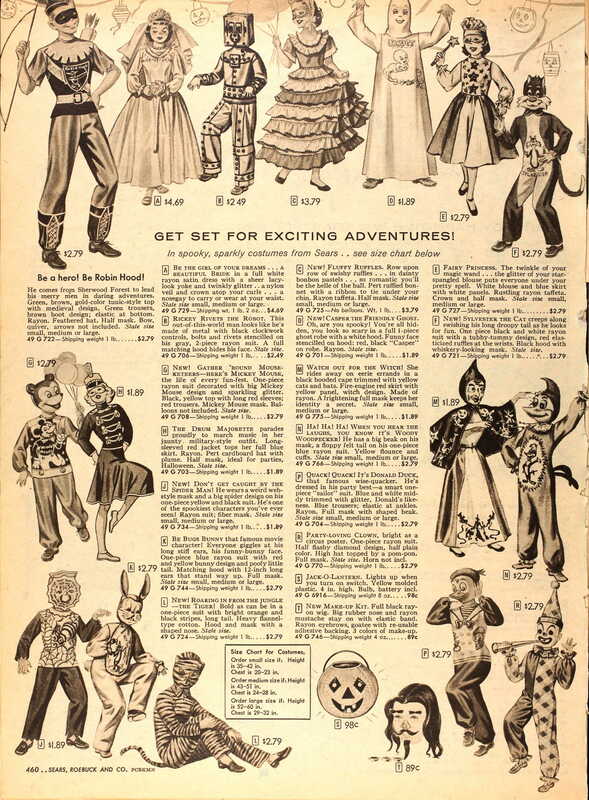
Sears, fall 1956. By this date the color split is easy to see.
Catalogs moved slower than columns
Sears and Montgomery Ward in the 1920s and 1930s still sold piles of white and pale garments with no sex printed under the picture. When pink and blue both appeared, the caption often read "pink or blue" as a choice inside one listing. That wording matters. A choice is not a code. I lay out the longer retail timeline, white layettes first, in white layettes, then pink and blue. The short version is that mass catalogs kept a neutral option on the page well after a few advice writers had picked a side.
Sears and Montgomery Ward in the 1920s and 1930s still sold piles of white and pale garments with no sex printed under the picture. When pink and blue both appeared, the caption often read "pink or blue" as a choice inside one listing. That wording matters. A choice is not a code. I lay out the longer retail timeline, white layettes first, in white layettes, then pink and blue. The short version is that mass catalogs kept a neutral option on the page well after a few advice writers had picked a side.
The mid-century narrowing
By the mid-1950s the pages I use most often had split "for brother" and "for sister," and pink sat on the girls' side in the big national books. The 1918 advice did not get a public funeral. It simply stopped being useful to the people laying out the catalog. If you date a family snapshot by hue alone, you will miss the decade. A pink sash in 1924 and a pink sash in 1958 do not mean the same thing, and sometimes the 1924 sash is on a boy.
Color is one column in the notebook. Closures, pockets, and the words under the picture are the others. For a garment-first method, see how to read a catalog romper. The rest of these notes live on the research blog.
By the mid-1950s the pages I use most often had split "for brother" and "for sister," and pink sat on the girls' side in the big national books. The 1918 advice did not get a public funeral. It simply stopped being useful to the people laying out the catalog. If you date a family snapshot by hue alone, you will miss the decade. A pink sash in 1924 and a pink sash in 1958 do not mean the same thing, and sometimes the 1924 sash is on a boy.
Color is one column in the notebook. Closures, pockets, and the words under the picture are the others. For a garment-first method, see how to read a catalog romper. The rest of these notes live on the research blog.